
Altisonus Logo

No Shortcuts. Ever.

Biamplification Required

Every Altisonus speaker ships without a passive crossover. Because crossovers are compromises. If you want one amp, one cable, one and done, buy someone else’s speaker. If you want to hear what your amplifier actually sounds like, keep reading.

Crossovers Steal Music

A passive crossover is 40 parts between your amp and your driver. Resistors burn power. Capacitors smear phase. Inductors saturate. You paid for a $5,000 amplifier. A $2 crossover just edited it.

Altisonus uses active crossovers before the amp, or no crossover at all. Each driver gets its own amplifier. Nothing in the signal path except wire. That’s why I require biamplification.

Cable Inside ≠ Outside

You bought premium cable. The speaker maker bought different cable. Will they match?

No.

You don’t get the full benefit of your cable unless what’s inside the speaker is the same cable outside the speaker (connecting it to the amplifiers).

If It’s Not Perfect, It’s Firewood

Vent alignment tolerance: 0.5mm. I’ve rejected cabinets for 0.6mm. Not because you’d hear it. Because I would. Each mirror-image pair is cut from the same wood stock, book-matched, then fine-tuned to your specific amplifier and cable. This is not production. It’s commissioning.

You Won’t Find Us at a Dealer

No dealers. No showrooms. No 5-star reviews from magazines we paid.
No “house sound” tuned in a boardroom.
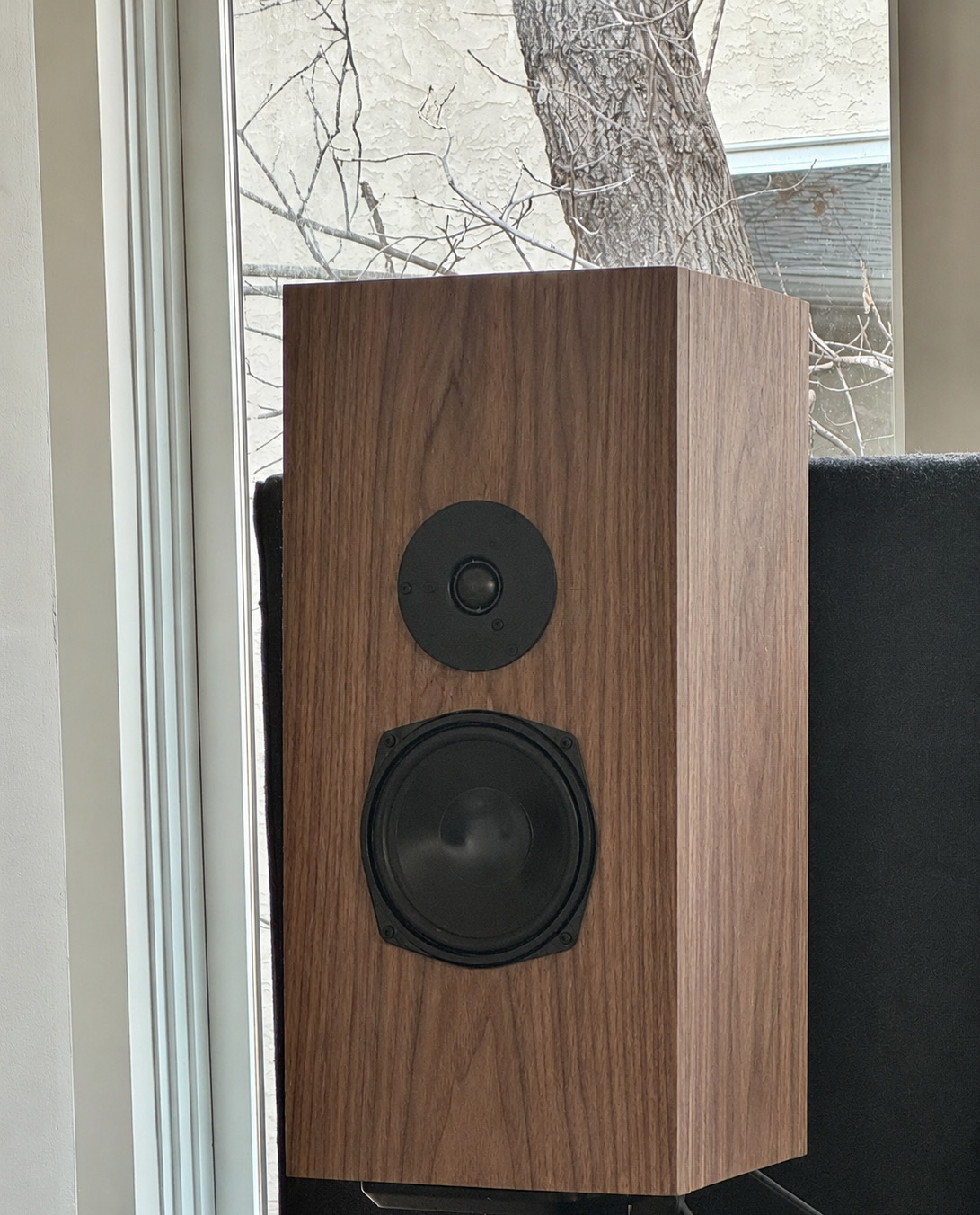
No MDF boxes wrapped in vinyl pretending to be wood.

If you need the safety of a recognized logo, we’re not for you.
If you want the speaker your neighbor hasn’t heard, and your system isn’t ready for… welcome.

Fly to Kansas. Bring Your Amp.

You call.
We talk about your room, your amp, your cables, your music.
Then you come to Bonner Springs.
We tune a pair to your gear.
If you buy, we ship.
If you don’t, the whiskey’s free and you still learned something.
Each commission takes 8 weeks.
I build 6 pairs a year.
When they’re gone, they’re gone.

Signed,

The New Guy

I’m Kermit. I built Altisonus because I was tired of apologizing for physics.

Established brands sell heritage. I sell performance. If that sounds unorthodox, it is.

The laws of acoustics don’t care about your logo. Neither do I.

No shortcuts. Ever.

More Details

What’s your background?

Pro audio guy since 1975, I have a thorough understanding of what’s going into the speakers. I’ve done analog recording, digital recording, mastered vinyl records, mastered CDs, and designed then hand crafted studio monitors.

Why do you require biamplification over passive crossovers? Lots of good speakers have passive crossovers.

Why Biamplification is Required
Control and efficiency. Nothing else preserves the design.

1. Amplifier Control
Each amp handles only its driver’s range. No wasted power. No intermodulation between woofer and tweeter signals.

2. Damping Factor
Direct connection to the voice coil. No inductors or capacitors in the path. Tighter bass, better transient control.

3. Zero Power Loss
Passive crossovers waste 10% to 30% as heat. With biamplification, 100W to the woofer moves the woofer.

4. Precision Filtering
24dB/octave or 48dB/octave slopes without phase shift. No passive crossover interaction. No frequency or transient anomalies. Steep slopes protect tweeters. Driver overlap is minimized — overlap degrades sound.

5. Level Matching
Turn the amp down. No L-pads. No power loss.

6. Time Alignment
More precise and practical than passive. Exact, not approximate.

7. Easier Load
Woofer impedance swings 4Ω to 40Ω near resonance. Biamplification isolates that load. Tweeter amp never sees the bass peak. Both amps run cooler, cleaner.

What is biamplication and triamplification?

Biamplification / Triamplification
Electronic crossover splits signal before amplification.
Biamplification: separate amps for woofer and tweeter.
Triamplification: separate amps for woofer, midrange, and tweeter.

No passive crossover in the speaker.

Why do you require that the speaker’s inside wiring be the same as the cable connecting it to the amplifiers?

Because every cable, regardless of its quality, has a different “sonic signature.” The only way to guarantee the highest qualiy sound is to use the same cable “inside and out.” No unforseen interactions. No inadvertent quality loss. No modification to the overall sound. Perfect match, perfect sound.

Why solid wood instead of MDF or an exotic composite?

Because solid wood and the best-grade ply benefits the speaker's beauty and heirloom quality. MDF benefits corporate profits. Exotic materials benefit ad copy. Solid wood or ply requires careful, painstaking old-school craftmanship. Good. That’s what I enjoy. MDF and exotic materials requires soulless machines. No. Just no.

How do you build the cabinet?

Basically, a box-in-a-box. An inner “core box" of Baltic Birch plywood, braced and damped, inside the “dress box” made from your choice of wood or a combination of solid wood and Baltic Birch plywood. The Core and Dress Boxes separated by vibration-absorbers. No vibration transferred to the Dress Box, ruining the sound. The Core won’t vibrate unwanted sound into the drivers. Acoustically-inert cabinets without exotic materials. Just craftsmanship and strategy.

What is the Altisonus Bass Recovery Module? Why would I want it?

Below a certain frequency, your woofer’s bass sound waves wrap around the cabinet. You lose half the bass. Your speaker sounds thin. The cabinet stole your bass.

The Altisonus Bass Recovery Module connects between the electronic crossover and the woofer amplifier. Gives back the bass the cabinet stole. No distortion. No DSP. No power needed. No adjustments. Brainlessly simple. “Bookshelf speaker” turns into a “full-range monitor.”

Is it just you making speakers?

No, I’m privileged to work with a dedicated group of musicians and audio engineers whose passion is to create the finest loudspeakers, audio equipment and sound recordings that are technologically possible.

Do you take commissions for car speakers?

No. I recommend Alpine, Dynaudio, Focal, or Morel. Insist the installer use biamplification or triamplification. If they say it’s unnecessary, walk away and find a better installer. Mercedes owners, ask for the Burmester upgrade.

Do you take commissions for PA speakers?

Yes. Matched to your venue’s acoustics. Biamplified or triamplified, of course. Cardioid bass bins for clean yet punchy bass. It’ll sound better than most audiophile stereos.

Do you take commissions for home theater speakers?

Yes. Biamplified or triamplified, of course. Better than the local theater, the equal of the best soundtrack mixing studio in your home. Popcorn included.

Why don’t you make lots of speakers like other companies do?

Everything I build, by hand, is the result of my experience that mass produced products require compromise, something I’m not willing to do. Altisonus is an outgrowth of my commitment not to rush new speakers onto the market each year just to have a new product. I take whatever time is needed to get the speaker right because I will not be not satisfied until it’s right.

Have you done any research or are you just designing using off-the-shelf software?

I have been researching loudspeaker design, along with other related audio topics, since 1976. This research, my real-world professional audio experience, and one of the largest privately-held research libraries, directs my design approach. In 1980, I finalized a comprehensive loudspeaker quality standard, SRA 2C4480, that inclues a method of objectively measuring the accuracy of a speaker’s stereo imaging.

Do you really junk a speaker for miniscule errors?

Yes. Several times. Even expensive speakers. Good enough is not good enough. No shortcuts. Ever

One example is this Descartes, the cabinet was junked. See the problem? Look at the edge of the right side, near the front. A long, raised ridge of wood grain. Sanding didn’t solve it.

What is your warranty?

Lifetime. Excluding abuse or “Acts of God."